What does the creative director for a town do?
Every collaborator owns a part. Almost nobody is hired to own whether the parts become a place. That job has a shape: Discover, Translate, Hold. (And yes, it's different from the CEO or developer's role.) And a case study of my work in Trilith.
———
This is a job almost nobody in development knows exists.
Which is inconvenient, because it's also my job.
Most developers know exactly why they need an architect, a civil engineer, a landscape architect, a planner, a contractor, a finance team. Those boxes are already in everyone’s pro forma. The scopes are understood. The fees are expected.
There is almost never a box for a creative director. So it can sound like a made-up role—an extra opinion with a fancy title.
It isn't. Great brands have creative directors. So does nearly every 30-second ad. A film has a producer and a director for a reason: someone makes the thing possible, and someone holds what the thing is. We treat that split as obvious when the product is a film, a sneaker, or an ad. And somehow we skip it when the “product” is a town that will cost far more, last for decades, and impact the quality of so many people’s lives, all day, every day.
Ask this in your next project meeting:
Who here is responsible for what it will feel like to be there?
Not the buildings. Not the landscape. Not the budget. The place.
In most places, everyone can do their job well, the math maths, and the place can still fall short. Nobody failed. There was a job nobody had.
The job nobody had
Good people in every one of those normal pro forma roles care beyond their lane. But almost nobody's contract says: make sure all of this adds up to a place people will love.
If you're a developer, you may be thinking: that's my job. I hold the whole thing.
You do hold a whole: the venture. Capital, risk, timeline, return, whether the project gets built at all. That is an enormous job, and the plate is already very full.
A creative director holds a different whole: the place. How will someone experience it on an ordinary Tuesday? Will they come back?
Those are not the same whole. A project can succeed as a spreadsheet and fail as a place. It can look beautiful in drawings and fail as a business. Neither is a win.
A town architect or a master planner covers part of the job. Sometimes a founder with a strong eye, or an architect who can't stop thinking past the building, covers it unofficially. Most projects never give anyone the whole job officially.
Project management asks: are all the pieces getting done?
Creative direction asks: what kind of place is this becoming?
Twelve good dishes can make for one weird dinner
A potluck can be lovely! It can also be extra-garlicky kimchi sliding into lime Jell-O salad, someone's grandmother's legendary mac and cheese, and gas-station sushi. Nobody did anything wrong. (Debatable on the sushi.) But nobody thought about what belongs together, or how the table should feel. It isn't a meal.
That's how most places get made.
A chef starts somewhere else. She pays attention first: season, what's nearby, who's coming, the budget. She composes a menu—nutrition, yes, but also balance, texture, color, flow, the whole table. She is not trying to make every dish taste the same. She wants each one fully itself, in relationship to the others. In a big kitchen, she may barely touch the food. The people at each station are better at their station than she is. She often isn't the owner or manager. Her job is the meal.
You can also plan dinner by calories. It would function. And calories matter. Engineering, code, stormwater, and ROI matter. A place doesn't survive without them. I have just never heard anyone describe an extraordinary meal as "it successfully contained 2,000 calories."
A place is too expensive, and too tied to the quality of people's everyday lives, to settle for sufficient calories or the gamble of a potluck.
I think of Discover, Translate, and Hold as the three stages of that work: figure out what the meal should be, make sure every station knows what that means, then keep the kitchen cooking the meal.
Discover: Before you design the thing, figure out what it should be
Discover comes first, and it is the stage most projects skip.
Developments tend to jump fast from we own this land to let's draw a site plan. Consultants get hired, budgets lock, engineering starts. Every step makes the first idea more expensive to question. One of the most expensive mistakes in development is getting very efficient at building the wrong thing.
Trilith is a new town next to a film studio south of Atlanta. When I arrived, a lot was already set: the site plan, the business model, roads starting to go in. But what the place was for was still surprisingly open.
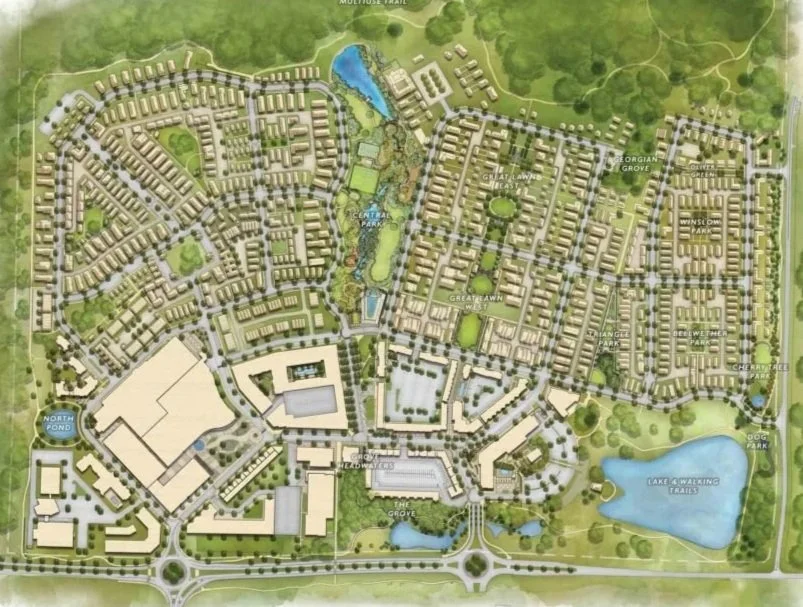
Lew Oliver’s site plan (already in motion when I arrived). The film studios were already built and making big movies. They are below this map, across the roundabouts.
The founder wanted a town that would serve the people working at the film studios next door. By then, I'd been dreaming about a town for highly creative people for eleven years. That dream had sent me deep into research on what creative and highly sensitive people need to flourish, and into flourishing more broadly.
I thought about it like curb cuts. They were designed for wheelchairs, and they ended up helping everyone: strollers, suitcases, bikes, tired feet. What if we designed a place especially carefully around what creative people need to flourish?
When the founder asked me to show him what I meant, I had years of organized images ready to pull from. He looked at a few on my laptop and asked to see them all at once. So he handed me a check for a printer, and I covered the office walls.
Then came months of listening: to the small team already there, to the surrounding community, to the long history of the land itself.
The biggest Discover moment came in an all-hands meeting. One idea on the table was building streets that could double as film sets, so believable that crews could shoot there. It's a natural idea next to a studio. Then someone from the film side, probably Frank, pointed out how much room a crew needs. Someone else did quick math on street widths. They'd have to be huge. And we'd all been counting on narrow, walkable streets.
The founder turned to me: what did I think?
I said I thought the narrow streets mattered more. Let the studio side be built for filming. That's what it's for. And let people walk across the street and feel like they're home. Not still at work. Not stepping around a film crew on their way to breakfast.
Afterward, I told him I thought he had two paths. One led toward a destination: spectacular, fun, FanTown. The other led toward a home for the people who make the films. Both were legitimate. There were people far better than me at the first. I'd love to help with the second.
He chose the hometown, almost immediately. And he thanked me for being willing to wrestle with him about it.
The words took longer. "A town for creatives" was where the dream started, but some of the team worried it sounded exclusive, and they had a point. One of our head builders, a longtime local and an early friend, told me quietly, "I hear all this stuff about creatives, but as far as I'm concerned, they're unicorns. I'd never met one till you came in the door."
What lit everyone up was designing for flourishing. Around then, the founder handed me Warren Berger's A More Beautiful Question, and something clicked. Instead of a label that sorted people in or out, we could build around questions everyone could share:
How do we build a town designed for flourishing?
And more specific to this place: How do we build a town designed for creating?
Internally, we also asked: Can we create a place designed for flourishing with professional creatives as the primary target, and includes everyone else, too? But the main focus shifted to flourishing more broadly.
It’s the curb-cut idea again. Design for flourishing, and it serves the creatives and everyone else.
So much snapped into place more easily after that: the website, the marketing, the sales conversations. The school followed naturally, with its own question: what does a flourishing child look like?
That's what Discover is for. You don't start with a vision and force the place to comply, any more than you'd walk into a kindergarten class and announce: you'll be a doctor, you'll be a musician, you'll be a mechanic. You pay attention until the place starts telling you what it could be.
Translate: Turn the vision into something people can build
Almost every project has a vision statement. Most of them say something like vibrant, sustainable, connected community. Then the civil drawings come back looking exactly like everything else.
Vibrant, sustainable, and connected aren't clear or specific enough to build from, so people just do what they always do.
Translate is the stage where the vision becomes something each discipline can actually work with.
At Trilith, the CEO at the time asked me to write what we came to call VPCs: Vision, Purpose, Concept. What are we doing, why, and how. I made one for the town as a whole, then for the homes, downtown, landscaping, branding, marketing, events, and sometimes even small pieces, like a railing. Then I built a private website so everyone helping build the town could see the whole vision and clear direction for their part.
That's how a vision scales: not by one person making every decision, but by giving dozens of people enough clarity to make their own decisions in relationship to the whole.
For example, let's look at how landscaping connected to everything else. Philip Shell, our original head of landscaping, was fantastic to work with. The yards at Trilith are tiny compared to most neighborhoods, and he found a way to run all the utilities through a single trench, even though plenty of people insisted it couldn't be done. (Solving the town’s hard/functional needs.) Together we wrote design principles for the landscaping of the homes, the downtown, and the parks. We both loved the rules. They pushed us, held us accountable, and gave us ideas.
Density was another concern the landscape principles took on in hard and soft ways. We were putting a lot of buildings close together out in the "middle of nowhere," and people were understandably nervous about how it would feel. I'd read research from Elaine Aron that Highly Sensitive People (which, I’d argue, most professional creatives are) need more time in or looking at nature. And research by Clare Cooper Marcus and her collaborators recommends that hospital healing gardens be roughly 70% green to 30% hardscape. If that's the recommendation for places designed to reduce stress and help people heal, let's aim for it in the town. We couldn't hit the 7:3 ratio everywhere, especially in year one, but we made it a goal to move toward. In practice, that meant a lot of vines planted along a lot of walls.
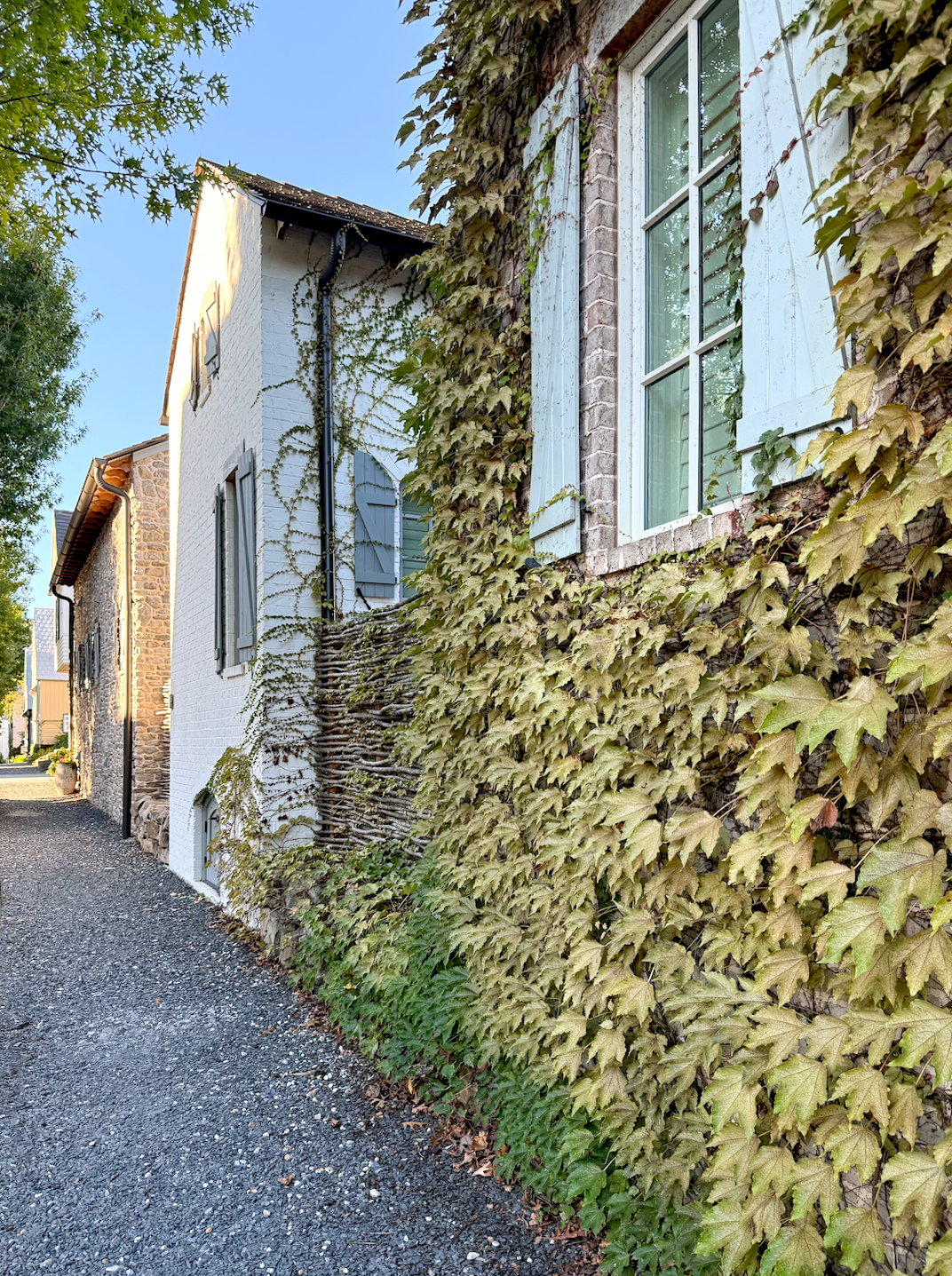
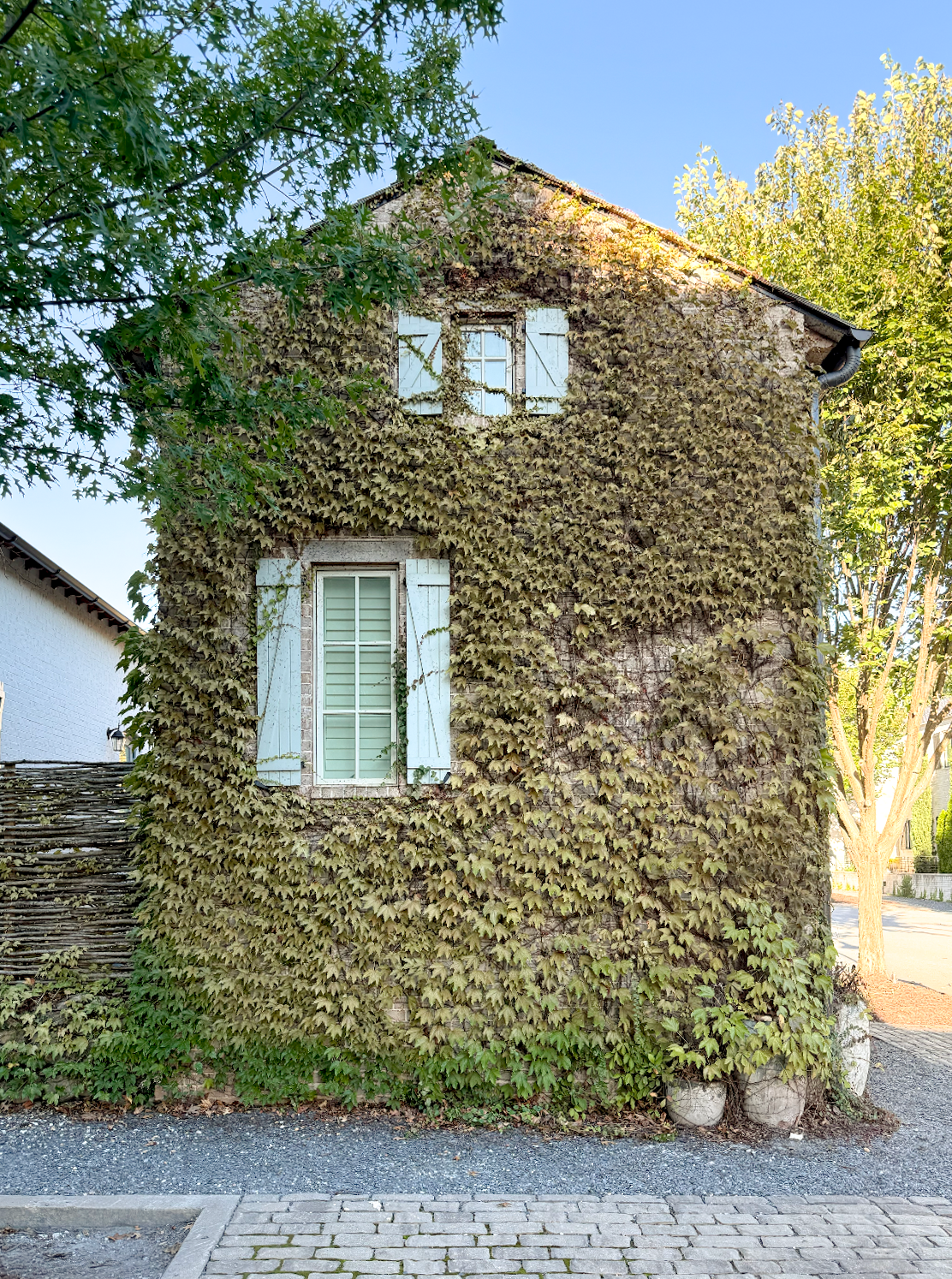
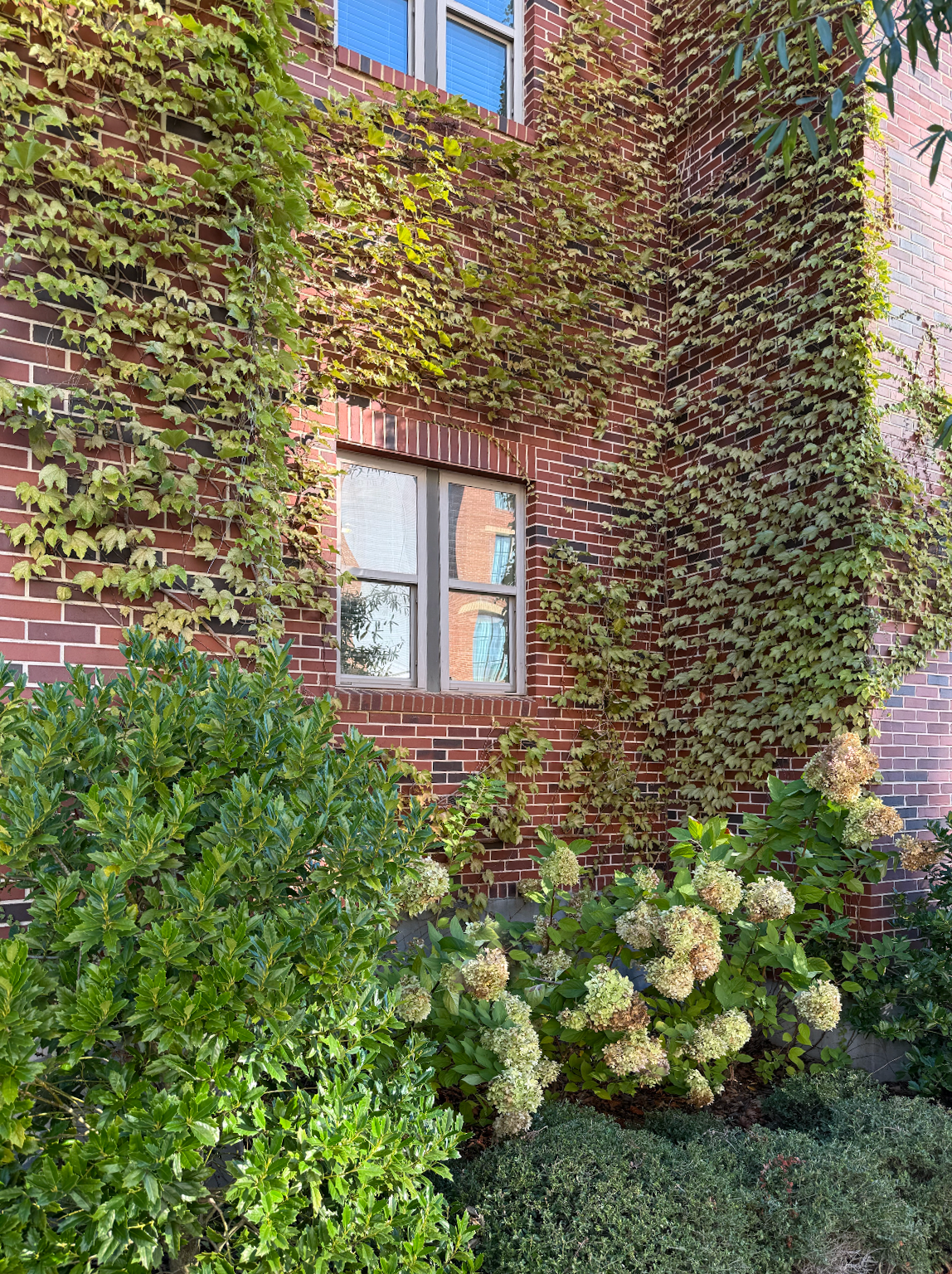
Years later, I notice people slow down (and take pictures) in the areas closest to that target and comment on how beautiful the town is.
Sometimes translating means handing a specialist a clear brief. Sometimes it means rolling up my sleeves. When Philip was swamped one week, he asked me to design the front half of Lew’s Great Lawn. I made it a sequence. Closest to downtown, a big day garden: mostly open lawn for breathing room, play, and picnics, with borders planted in blues and whites to feel like open sky. Next, a smaller lawn ringed with white fringe trees and a pavilion. Eventually, I think people will have weddings there, and the rest of the time it's a great place for neighbors to bump into each other and grill out. On the far side of the pavilion, there's a more intimate night garden in a moodier palette, full of fragrant, night-blooming plants.
None of it cost more than what was already budgeted for landscaping.
Almost nobody is consciously aware of the design.
But it makes me happy to see kids playing in the day garden, and neighbors grilling out together and sharing a glass of wine on the evening side. It actually happens!
Hold: Keep it becoming that
Once building starts, the decisions multiply. Hundreds, then thousands. Budgets tighten. Specialists optimize their piece. Value engineering starts looking for cuts. Construction reveals things nobody could have known from the drawings.
Hold is the work of keeping all of those decisions pointed at the same place. It keeps asking one question: are we building the thing we said we were building?
A film director is a good comparison for this stage.
A director doesn't run the camera, set the lights, or act the scenes. The cinematographer, the gaffer, and the actors are the experts at their crafts, and a good director lets them be. But she knows enough about each craft to ask for the right thing for the specific whole she's aiming for: move the camera six inches. The light should feel like early morning. Give me that line again, but don't perform it. And everyone on set knows they're making the same movie.
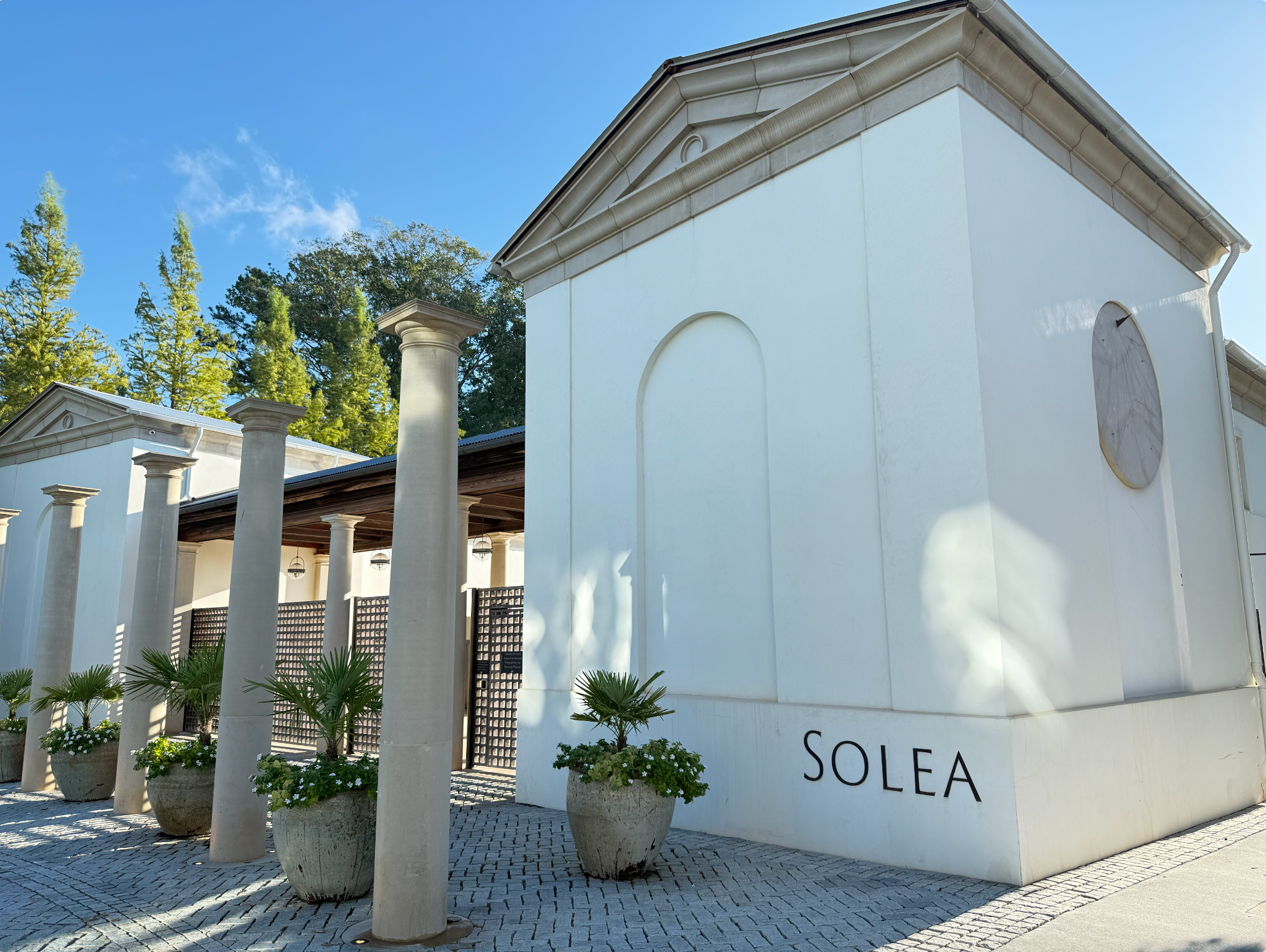
The entrance to the community’s pool. Designed by Keith Summerour. Inspired by several points of inspiration, including Roman bathhouses, particularly in Bath, England.
At Trilith, that meant sitting at the table with ultra-talented architects like Keith Summerour to design our pool. I advocated for bringing Keith in because I respect his work so much (as in: I’m certainly not trying to micromanage him!), and I think he enjoyed the collaboration because I was helping him shortcut his Discover phase. I came to our first meeting with a VPC for the pool, ideas and images, and an open mind. We talked through ideas while he sketched, and the concept evolved right there. Whenever sitework or code questions came up, we called over one of the civil or construction guys. We compressed into one work session what often takes weeks, if not months, of feeling around in the dark and rounds of revisions. And felt pretty exhilarating for everyone. Our CEO was in and out of the room for a lot of that meeting. Afterward, he shook his head, “I’m not really sure what just happened at that table, but…it felt as much like magic as anything I’ve seen”
It meant working with Lew Oliver on the residential architecture, and with Dana Lynch, who led the residential interiors, on design principles and color palettes for the homes that were earthy and sophisticated, and then letting them run. It meant working with several more architects and firms on a different set of principles and a broader, more energetic palette for the downtown. It meant rules with Philip like no pansies (too expected) and as many native plants as possible.
Day to day, holding a place looks like a FaceTime call from a builder in the field: "Where do you want me to put these house numbers? I can't find a good spot."
He showed me the options, and he was right. Tough call. Then he had someone hold the numbers up, and my eyes got wide. Where did those come from?
He'd picked them up on the way in that morning. The first few houses needed them to get their CO that day.
He was doing his job exactly right. House numbers just weren't anyone's job. They'd fallen through the cracks, and those were about to be nailed to the front of every house.
We found a short-term fix. Then I worked out a better long-term solution for all of them. It wasn't the brass plates I wished we could do, but it was on brand and on budget.
A tiny version of the job nobody had.
Holding also means deciding what to let go of during budget cuts, and what to fight for.
It takes some authority, and that's the part that makes people nervous.
A creative director doesn't outrank anyone as a person or as an expert. The landscape architect knows more about landscape. The engineer knows more about stormwater. The creative director is accountable for something wider, the whole place, and that's its own kind of expertise. When a good solution to one problem hurts the whole, someone has to be able to push back and ask for another.
There are limits, of course. If a beam can't move, the beam wins. Code, structure, and whether the project pencils out are the constraints the whole place has to live inside. But if a stoop can move while it’s still lines on a screen, and the street suffers if it doesn't, the street should win.
Creative direction isn't protecting an idea from reality. It's synthesizing reality into a better answer.
For that to work, the creative director needs a direct line to whoever holds final authority on the project, and clear design authority across the disciplines. Responsibility without authority is just a title.
Here's what that looked like with a railing.
Make it remarkable (for the price of a generic railing)
Even before there was a town, when I got there, a stone bridge crossed over ponds to create the entrance. The bridge needed a rail.
The first brief from the founder was simple: don't worry about money. The railing would be one of the first things built, and one of the first things anyone saw every time they arrived. Make it remarkable.
(Every numbers person reading this just flinched. Every artist got excited.)
Let's go! I put together several proposals for railings that were really kinetic art pieces, things that would move in the wind or as you ran your hand down them on your way in, some with lights that responded to you. Our fabricators were half nervous, half excited. Our builders and site crews went through each idea to check what would pass code.
Then the real budget showed up, and the plan quickly pivoted to ordering a standard metal railing the next day.
I was sad to let go of the art pieces, but I wasn't ready to put in the same railing you'd find on any overpass. OK, there IS a budget. That's fine. It actually felt good to know what cards were really on the table.
I asked what the standard railing would cost and if I could have a couple of days. Could I find something that met both the "remarkable" brief and the real budget?
They gave me the days. And, fortunately, I found it: wattle!
Wattle, which is woven branches, is one of the oldest ways to make a fence. (And fun to say.) People had used it on this land before recorded history. It was also used in England, where the studio our town grew up around came from, and everyone wanted visual ties to it. Almost nobody builds with it anymore, so it felt old and new at the same time.
I showed my code experts. "Huh, that's cool. I've never seen that…but I don't see why it wouldn't pass."
I showed one of our grounds guys some pictures and asked him if he thought he could do something like that. His eyes lit up. "Yeah! I think we can do that! I love it! And there's a whole bunch of small trees in the back we have to clear soon—we could use them!"
So instead of hauling them off or burning them, we wove them into the entrance.
It felt wonderfully here.
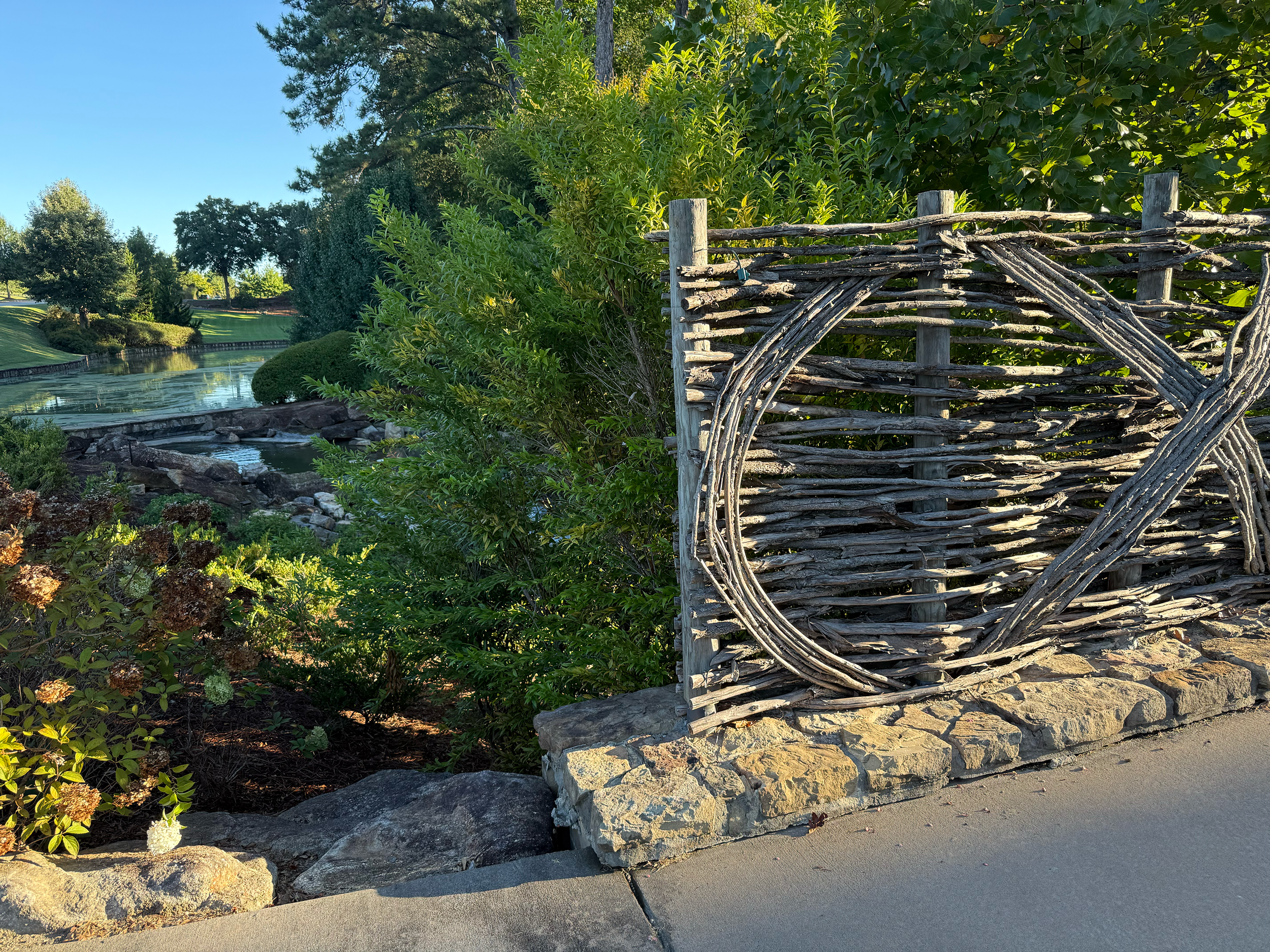
The wattle railing over the stone bridge entrance to Trilith was built before there was a town.
That's my favorite kind of design solution: not necessarily my first one, but the one nobody at the table could have arrived at alone.
And it came in barely over the cost of the generic railing, which was still within budget. Everyone liked it so much that they accepted it would need rebuilding every so often.
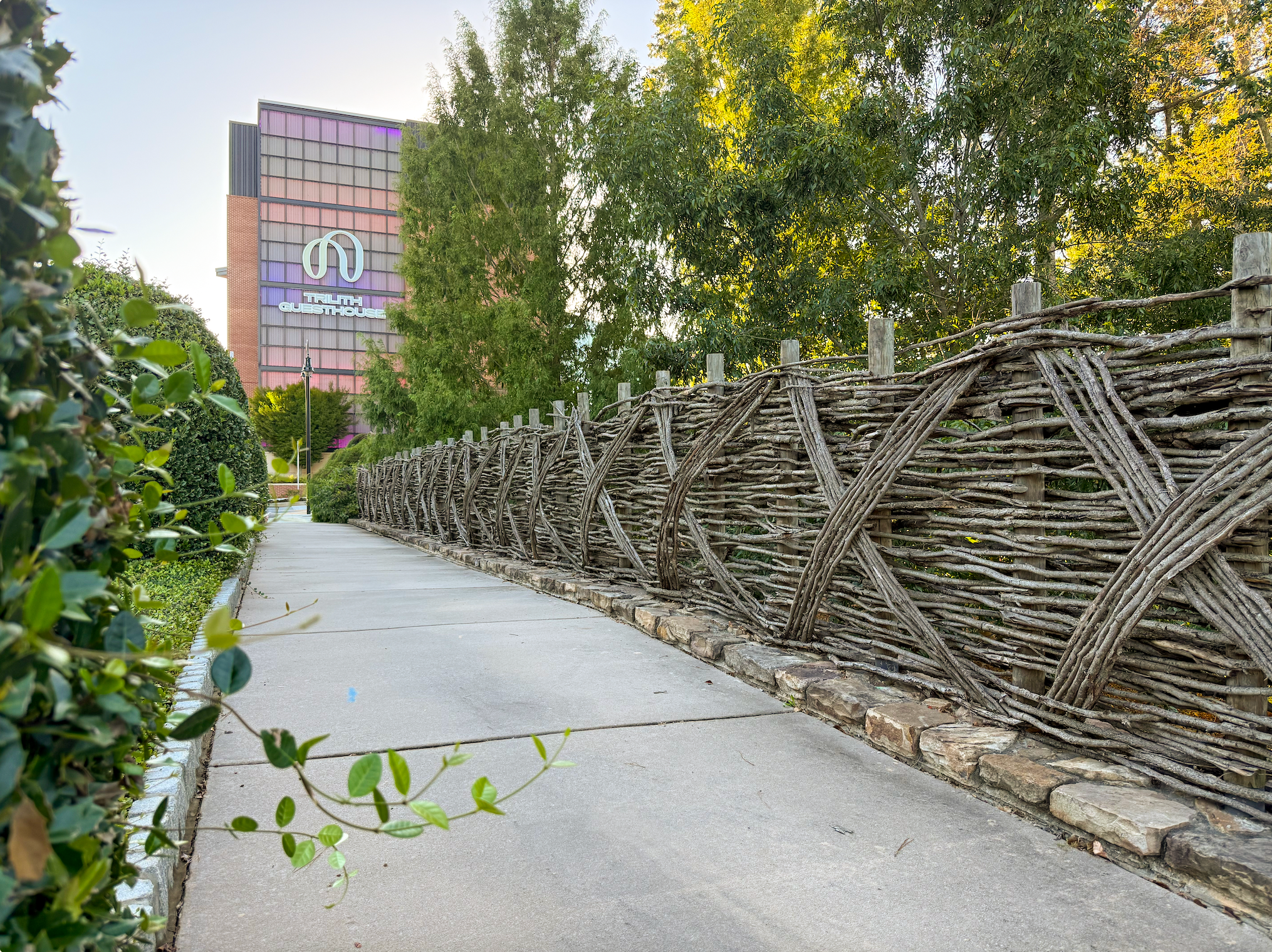
Almost ten years later, it’s still there (well, its successor) welcoming everyone into the downtown.
It even became a kind of signature move. Wattle started showing up in other design proposals that came across my desk: a front yard here, a transformer cover there. What was almost a generic railing became a unique part of how the place speaks.
Normally, nobody's scope says make sure the first thing people see tells them where they are.
But that's the job.
Same job, bigger kitchen
People sometimes ask how designing a single home connects to designing a town.
My discipline is the whole. The size of the whole determines who else needs to be at the table.
On a house, I might draw the plans myself and pick the materials, lighting, furniture, and art, and work alongside a landscaper, engineers, MEP, and construction teams. On a town, I'm mostly holding the relationships between dozens of specialists who know their piece far better than I do.
The kitchen gets bigger. The job is still the meal.
And the questions stay the same at every size. A town can fail the same way a house does: when nobody is asking what it will actually be like to live there on an ordinary day. [More on that in One House or a Thousand.]
Where it goes in the pro forma
So where does a creative director go in the budget?
Creative direction belongs in the project's design soft costs. Not as an add-on at the end, but as work that starts before the site plan and continues through construction. The investment roughly follows the work: most intensive early, during Discover and Translate, then steady through Hold.
This isn't about spending more to make things pretty. The "soft" qualities show up in hard places: whether people come back, how long they stay, whether they tell their friends, whether tenants want to be there, and how the place ages. The more generic, interchangeable, and copy-pasted a development is, the more heavily it has to compete on things like price, location, and amenities. A place people genuinely love has something harder to substitute. And a place people talk about needs less help getting talked about.
Relative to a development's total cost, it's small, and it protects everything downstream. We wouldn't build a $100 million restaurant, hire extraordinary farmers and cooks, and decide the chef was an unnecessary line item.
And the earlier it starts, the more it's worth. Discover costs the least before the site plan or pro forma exist, and can cost the most to skip. (What if they’d decided they did want to film on every street and did need the wider roads?)
A place isn't experienced as a pro forma or a piecemeal of disciplines.
Someone wakes up there. A kid walks to school there. Someone opens a shop and spends twenty years trying to make it work. Someone sits under the tree. Someone falls in love there. Someone gets old there.
At Trilith, I'm happy to say the town is evolving, and the center is holding.
The town had to change its name. Which meant the branding we made was replaced. Much of the original team has moved on, including me. New people have arrived and added things none of us imagined.
That's supposed to happen.
A place isn't a finished product, and a creative director shouldn't make it depend on her forever.
This fall, they're hosting their first annual Flourishing Summit.
The question is still doing its work.
Lesson learned:
Successful creative direction: you discover something true enough about a place that eventually it doesn't need you to keep telling everyone what it is.