What Apple got wrong
Part three of a series. Part one argued that a place needs someone to hold the whole. Part two argued that person's answers should come from something you can check. This one is about what happens when she's wrong.
The critiques
I carefully followed the critiques about Steve Jobs in the early years of my thinking about placemaking.
This was nearly twenty years ago, when I was just starting to think seriously about towns, and the stories about Jobs were everywhere: the control, the open v. closed debates, the way one man's taste shaped a hundred million things in everyone’s pockets. Some people were admiring, some were upset, and I saw I could apply every word of it to designing a town without changing anything but the nouns.
A town built on one person's worldview is a mixed bag. Like anything designed, it embodies the designer's worldview—strengths and weaknesses. The difference is that with a phone you can trade it for a new one if the blind spots bother you enough. With a town, you live in it. Your kids live in it. The people who never chose it live in it. And it’s very expensive (and unlikely) to change very much.
That's why I've spent so many years trying to see, examine, and develop my own worldview clearly before I externalize it into something that can't be moved and could impact so many people’s lives.
I've spent two posts making the point that a place needs someone with the authority to say what it should be, and that authority should come from patterns and evidence, not taste. If you've been reading along and getting uncomfortable, good. It is uncomfortable! Because a thoughtful reader should be asking: fine, but what if they’re wrong? What if she mistakes her preferences for patterns? What if nobody around her is able to say so?
Apple, of all companies, is a good place to look for an answer. Not because they got it right—but because they got it wrong in a way that's easy to see.
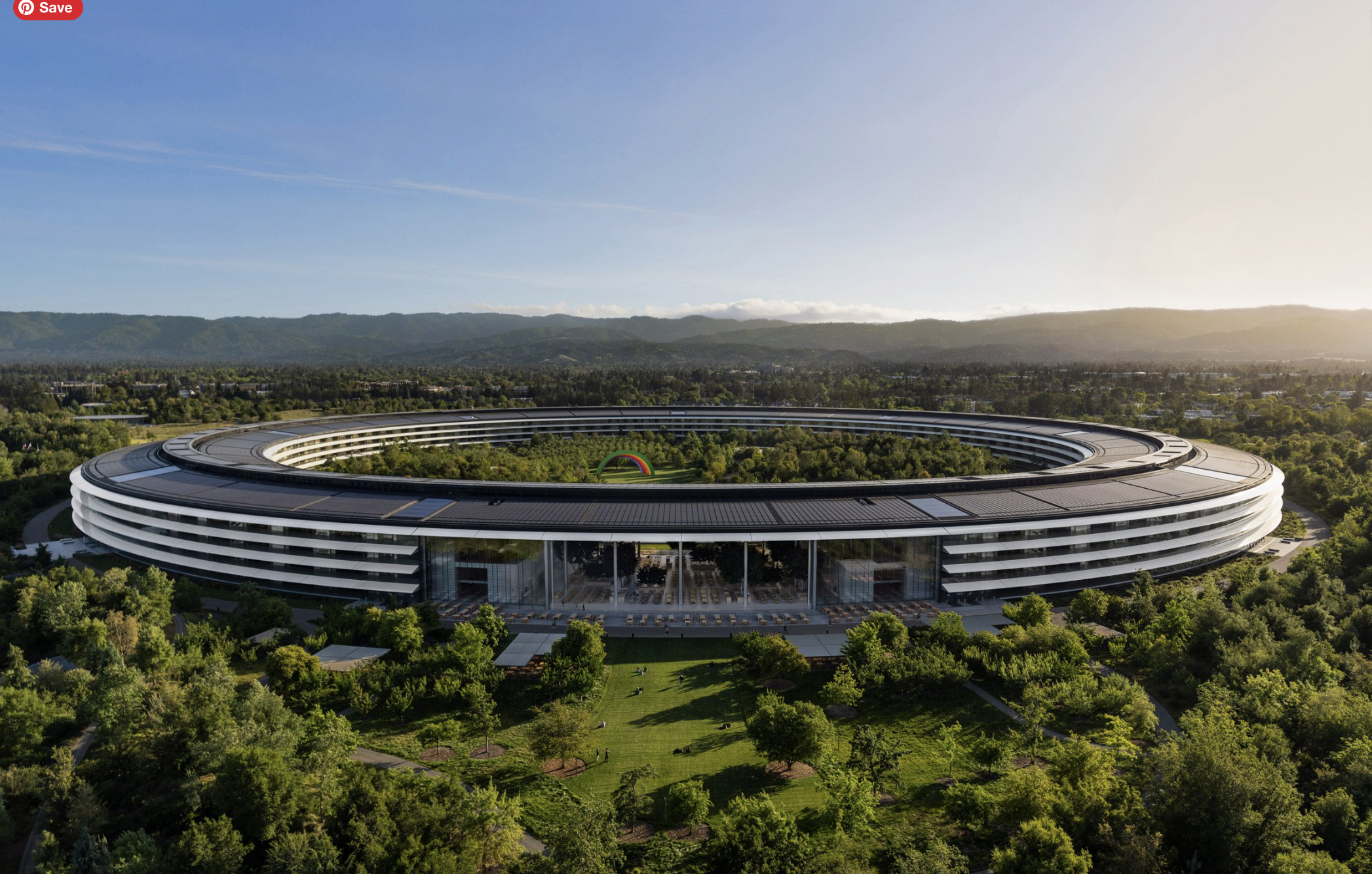
Apple Park via Dezeen
APPLE MAKES A PLACE
On June 7, 2011, Steve Jobs walked into a Cupertino city council meeting to ask permission to build a building. It was one of his last public appearances. He was thin and clearly unwell, and he'd come in person, which he didn't have to do, because he wanted this one.
He showed them a ring. A single circular building, four stories, set in what would become a small forest of native trees. "It's a little like a spaceship landed," he said, and the council laughed, and he smiled, and he told them it would be the best office building in the world.
He died four months later. The building opened in 2017. It cost something like five billion dollars, and it is, by most accounts, extraordinary. The glass is the largest curved panes ever made. The door handles were redesigned more times than most buildings are. It’s a monument to the idea that nothing is too small to care about.
And it sits in the middle of 360 acres you have to drive to, with parking for more than ten thousand cars.
I want to be careful here, because it's easy to bash on Apple Park, and a lot of people have. That's not what I'm here for. The building is a masterpiece of the thing it is. What’s more interesting to me is what it isn't.
The most design-obsessed organization on earth, run by people who had just spent fifteen years proving that design means how the whole thing works, built a place. And the place is an object. It faces inward. It touches nothing around it. You can't walk to it from anywhere, and there is nowhere to walk to from it. The discipline that governed the iPhone, the refusal to hand off any part of the experience, became an expression of a closed object writ large. Very large.
I think their "should" was built for objects—things, and a place isn't one.
The rules are different for things than they are for places.
Objects and places
An object, a thing, is finished. Or at least finishable. Apple's whole genius was in finishing: sealing the case, hiding the screws, deciding every question so the person holding it never had to. You don't modify an iPhone. You use it, and when it stops fitting your life, or the next one comes out, you replace it.
A place is never finished. It keeps going long after the original builders leave. People move in and change it. They may open a shop where you didn't plan a shop and plant a tree where you planned a view. They disagree with each other about what it's for. They inherit it, and their children inherit their arguments. And a long time after the person who held the whole is gone, the place is still there, still being lived in, by people who never chose how the roads got laid out.
That's the difference, and it's not a small one. A phone has users. A town has residents. Subjects. People don't interact with a place; they build lives inside it. So a design approach that's perfect for objects (one mind, every decision made, the case sealed) can't simply scale up to a town. Scaled up, it's Apple Park. Beautiful, finished, facing inward. Closed.
What’s the actual product?
Here's the part I actually think Apple got right, though, and that we still mostly haven't. Apple's real insight was that the product wasn't the phone. It was the whole thing: the hardware, the software, the store, the box, the cable, the way it all fit together. They won because they refused to define the product smaller than it really was.
We make the same mistake with places every day. We think the “product”—the unit of living—is the house.
It isn't. Nobody lives in a house. We live in a community. The house is the part you sleep in, where you spend some of your time. What you actually bought (or didn't), whether anyone said so or not, is the walk to coffee, the neighbor who waves, the school, the street your kid can or can't ride a bike on, the tree canopy in August, the quiet at night, and the thousand small interactions that happen outside your front door. That's the “product,” for lack of a better term. The house is a component.
I don't love calling a community a product. But if we're going to think of where we live that way—and the market mostly does—then the product is the community, and the house is the part you can see on the listing. I think good designers and developers are starting to figure this out, because it's where the value is. It's also where the blind spots are.
Which brings us to the uncomfortable part.
A vision embodies its author
Everything Apple made embodied Steve. That was the point of the first post, and it was mostly a compliment. But look at the misses, and you'll notice they're all the same miss.
The Cube, in 2000: a gorgeous eight-inch block of clear acrylic that almost nobody bought. The 2013 Mac Pro, a polished black cylinder so committed to its shape that Apple later admitted, in public, that they'd designed themselves into a thermal corner. The sealed batteries. The keyboard that got thinner until it stopped working. The whole idea that the person holding the thing should never need to open it. That it should never need to change, evolve, or interact meaningfully with inputs outside its own system.
None of those are failures of care. They're care in a circle so tight it can’t be alive.
That's what a worldview does when it's poured into an object. It brings its strengths and its blind spots. The control that made the iPhone feel finished is the same control that makes it unrepairable. You don't get one without the other unless someone outside the worldview is standing there, with enough standing to challenge and develop the blind spots.
Now do that with a town.
We have, actually, and the examples are famous. Brasília is a magnificent plan by two brilliant men, built in four years, and it's a city where nobody walks, because its authors believed in the car and the monument and didn't much believe in the street corner. Robert Moses gave New York its parks and its bridges and also drove highways through neighborhoods he'd never lived in, because he was sure, and he had the authority, and for forty years nobody could tell him no. In every case, the vision was real, and the strengths were real. The residents just had to live in the blind spots.
That's the risk of what I argued for in the first post. I'm not backing down from the point: a place still needs someone to hold the whole, and the alternative, the committee, mostly produces meetings and mediocre places. And parking. But I'd be lying if I said the danger wasn't real. It is.
I've wrestled with these tensions for a long time.
Works for whom?
So here's what I've done about it, for what it's worth.
The first is just admitting the blind spots are there. I don't think I've found them all. I don't think anyone does. But knowing they exist is half the battle, because it changes what you do with certainty. When I feel most sure about a design decision, that's now a signal to slow down, not speed up. You know what they say about assumptions. :)
The second is a question I ask in every project, alongside the one from the last post.
That one was: Does this actually work?
This one is: Works for whom? (Honestly, I always say “works for who”…saying whom out loud feels so pretentious, haha.)
Because "works" is never neutral. A street can work beautifully for a thirty-five-year-old with a car and a dog and work terribly for an eight-year-old, or an eighty-year-old, or someone who can't afford the car. A town square can work for the people who look like the designer and not work for anyone else. Every worldview has a default person, and that default person is usually a version of the author. The only way I know to catch that is to keep asking who's left out, and then to go find them and ask with humility.
I need people who have lived outside my field of vision, and enough trust between us that they can tell me when I'm not seeing something.
Here’s an example. Years ago, a place I was connected to was getting busier, and some residents were feeling less comfortable about it. One response was more police presence. My first reaction was, more or less: okay, makes sense.
Not long after, I was talking with a Black friend who lived there, and she said she didn’t like it. She could tell I was a little surprised. She clocked it and said lovingly, “Oh, Joy…you’ve never been a Black mother. You’ve never had a Black son…” And she shared some stories with me that opened my eyes.
She was right. There were things about that decision I could not see from inside my own life. And I'd been looking. I was paying attention. I cared. None of that was enough.
The last post said: observe reality. This is the part I have to add. You can only observe reality from somewhere. No amount of taste, expertise, or pattern-reading would have fixed that blind spot. I needed someone whose life had taught her what mine hadn't, and I needed enough trust between us that she could tell me, and that when she said you're not seeing this, I listened.
The third habit is the one I want to spend the rest of this post on, because it's the one I think actually scales. It's about how you anchor a project.
Questions at the center
When I was creative director for a new town, I was quite uncomfortable with one person calling the shots. I'd also seen enough flat, everybody-decides organizations to know that the opposite is its own kind of purgatory. So I went looking for what else was out there.
What I landed on, thanks to a timely recommendation from the founder, was Warren Berger's A More Beautiful Question, and it was mostly this: instead of a mission, we built the place around questions.
Not vague questions. Questions that can have right and wrong answers—or at least better and worse ones. Questions you could hold a street section up against, or a budget line, or a decision about who gets to open a shop—and they will help you have better answers.
The mission statement we'd been hotly debating turned into a driving question: How can we build a town designed for flourishing? And we started a school asking a similar question: What does a flourishing child look like?
People can and do disagree about what that looks like or how to get there. Great! Those are the right things to argue about! What nobody could do was argue that the goal was wrong, because the goal was a question, and you can't be against a question. You can only answer it well or badly.
I now have quite a list of questions that flourishing places ask. Here are a few of them:
What do the people and the ecosystems here need to flourish, and how would we know?
Is it human scale? Is it a scale that cultivates care, both giving it and receiving it?
Would I be willing to step into the life of anyone here, despite our differences?
Can everyone rest and play? Does everyone have the time, energy, resources, and safety to enjoy life here?
How do we build so that this place is better in three hundred years, and recover faster after a crisis?
What is love asking us to do?
That last one gets a look from some people. I'm ok with that. It's still the question that catches the most.
Here's why questions work where a mission doesn't. A mission is an answer. It belongs to whoever wrote it, and everyone else either follows it or resents it. It automatically positions the whole project as adversarial.
A question invites. It can belong to everyone who asks it. Anyone in the room can pick it up, hold a decision against it, and say: I don't think this passes. The founder can't overrule a question. She can only answer it, out loud, and be argued with.
Those driving questions still shape the town and the school, years after I've moved on, and not because anyone is enforcing them. Of everything from my time there, that's what I'm proudest of. A vision that exists only because its author keeps enforcing it hasn't really taken root. One that has is a vision other people recognize themselves in, add themselves to, and make more complete than its author could have alone. "How do we build a town designed for flourishing?" isn't a conclusion anyone has to preserve. It's an invitation people keep answering. That's why it survives me.
Shared and yours
A question I get asked about that town, maybe more than any other, is this one: how much do people get to choose about the outside of their own house?
The answer is: very little. And I have mixed feelings about that.
The houses themselves are amazingly varied—every one is unusually distinct. Far from the usual four-model subdivision.
I think about houses on this spectrum that’s like…hermit crab on one end and oyster on the other.
Trilith is on the hermit-crab side. Lew Oliver designed this amazing collection of beautiful, distinct shells. I mean, really, it's a remarkable feat! The man is an endless well of house designs. I don't know how he does it. People get to choose which one they want to inhabit, which one feels most like them. And having that many different shells to choose from is so much better than pretending the same four will fit everybody, like most neighborhoods do.
The other end of the spectrum would be more like oysters growing their own shells—each perfectly congruent to their inhabitants. The form itself becomes an expression of the life within.
There's obvious beauty in that. There's also obvious risk. Christmas Vacation comes to mind...
So I don't think the answer is simply more freedom or more control. The line I'm interested in is between what's shared and what's yours.
The more a decision shapes the shared life of a place, the more it should answer to what makes the whole viable and lovable. The more it belongs primarily to an individual life, the more room it should leave for agency, difference, and expression.
Take a house. Its front helps make the street, and the street belongs to everyone who walks down it, ten thousand times, for a hundred years, hopefully. So I'd hold the house's relationship to the street pretty tightly: where it sits, how it meets the sidewalk, what the garage and parking do to the public realm, whether its edge invites life, whether the materials will age well.
I may advocate for some rules around the main exterior color of your house, because that color significantly participates in the street. That doesn't mean I need to choose your shutter color. And I certainly don't need a say in what you do inside your house.
Hold the relationship tightly. Hold the expression loosely.
A shop follows the same concept, but it works a little differently. Its personality—its sign, its windows, its interior, the weird little thing the owner puts outside every morning—is part of what makes a downtown exciting to walk through. Give it room to be livelier and more expressive in the public realm than a residential section.
But in a tiny downtown, the mix of businesses affects everyone. Seven coffee shops affect the viability of each other and the whole downtown. They make an ecosystem out of balance. So again, the question isn't how much control should we have? It's which decisions are primarily yours, and which ones participate in the viability of the whole? Sometimes what the whole needs is more difference, not less.
Underneath all of this is a tension that never really goes away: the flourishing of the individual and the flourishing of the whole. But I don't think the goal is a compromise between them.
The goal is a house that becomes more itself by strengthening the street, and a street that makes more kinds of houses possible.
Too much emphasis on the individual and eventually there's no whole. Too much emphasis on the whole and eventually there's no life on it. A living place needs both: enough coherence to become something together, and enough agency for the people inside it to keep making it more than its designer imagined. Said another way: enough space to love the individual components, and enough coherence to love the whole.
That's why facade rules still feel delicate to me. I believe in design principles. I believe we need ways to protect the viability and lovability of the whole. But I also want those principles to govern the relationships that make the place work, rather than unnecessarily prescribing the individual expression inside them.
Because the street is ours.
The shutter color can be yours.
What Apple got wrong
So, what did Apple get wrong?
Not the vision. Not the authority. Not the refusal to design by committee, or the insistence that someone hold the whole. All of that was helpful, I think.
What they got wrong was confusing coherence with closure.
For an object, those look like the same thing. The more completely every part is resolved, sealed, and repeatable, the more coherent it feels, and Apple could make ten million identical phones and call that success, because a phone is supposed to be a copy.
A place can't be a copy. Its particulars are the point: this soil, these trees, this climate, these people and what they've lived through. And living things don't get their coherence from being finished. They stay coherent while staying open, taking in what's around them, responding, adapting, letting their parts have some agency of their own, becoming more themselves over time. Anything copy-pasted is already a thing—an object, likely not alive. A place has to be alive, and alive means unfinished.
After so many years of holding these kinds of questions, I’ve come to believe:
The answer to bad vision isn't no vision. We've tried no vision. It looks like most of what's been built since 1950, and nobody flies across an ocean to walk around in it.
The answer is a vision strong enough to guide a place, humble enough to be corrected by reality, and open enough to belong to everyone.
Strong enough: somebody holds the whole, and has the authority to say figure it out. Or it's mediocre at best, more often worse.
Humble enough: her answers come from patterns and evidence and prototypes, things that can be checked, and she keeps asking who it isn't working for.
Open enough: the center is made of questions (and essence, but that's a post for another day), not preferences, so anyone can hold a decision up against them, and the place keeps asking them long after she's gone.
Steve had the first one, completely. He had more of the second than people give him credit for. He never had the third, and he didn't need it for most of his work, because a phone doesn't have to belong to anyone but its owner.
A town does. And here's the last thing, the one it took me the longest to be able to name.
The person who holds the whole isn't really inventing it. The best vision isn't imposed on a place. It's discovered with it. She's paying attention to what's already alive there: the shape of the land, the things people already love, the patterns of life that already work, what the people care about, what's missing, what the ecology can support, what this particular place might become that no other place could. Her job is to recognize it, give it enough form to take root, and leave it enough freedom to keep becoming.
That's what we build, if we're building the right thing. Not the house. Not the object. The thing people live inside, together, for a very long time, that has to keep becoming itself after we've stopped holding it.
Our Lessons learned
So, in case it’s worth wrapping up the lessons from this little series:
We don't have to confuse vision with control.
We don't have to confuse expertise with omniscience.
We don't have to confuse coherence with closure.
The purpose of coherence isn't to make the parts conform. It's to create a whole in which the parts can flourish.
Individual freedom isn't good because individuality is sacred regardless of consequence; it's good because living wholes actually need differentiated, agentic parts.
A living place isn't coherent despite the individuality of its parts. At its best, it's coherent partly because those parts are allowed to become themselves.