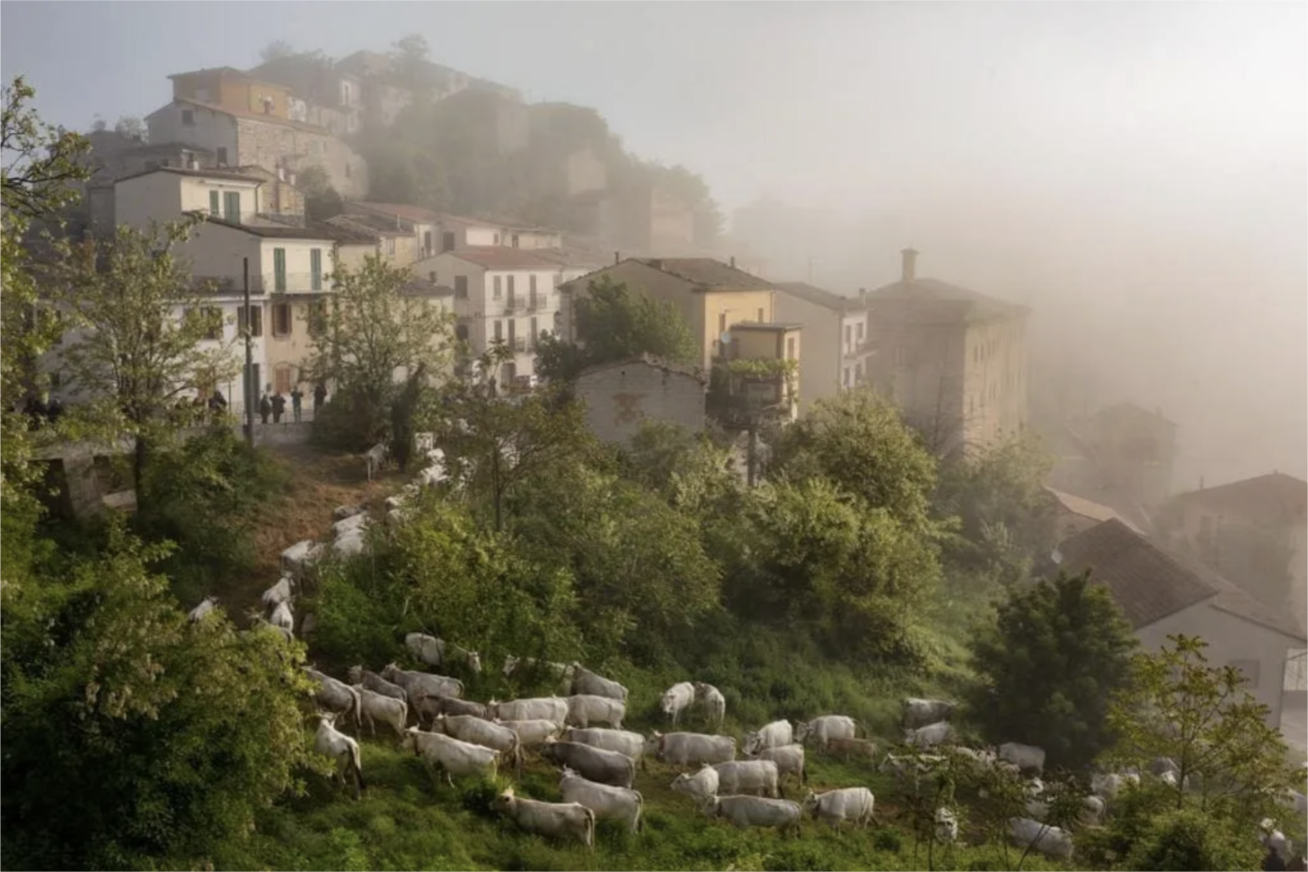
Castropignano, Campobasso province, Molise, Italy by Giuseppe Nucci for National Geographic.
Think about the places you’ve loved most. Places you’ve visited—and especially the places where you’ve actually lived well.
What made them so good?
Probably things like walkability, beautiful public spaces, nature, human-scale buildings, local businesses, a mix of uses, places to gather, and people you knew.
I believe in all of those things. A lot.
But think about old European villages that have almost everything on that list: beautiful stone buildings, narrow streets, a town square, architecture that belongs to its landscape. Some places have remained vibrant for centuries. And some of them are nearly empty.
The buildings are still there. The streets are still walkable. The views are still gorgeous.
But the life has thinned.
I’ve lived the opposite, too.
For a few years, I lived in a cookie-cutter suburban subdivision outside Atlanta called Swan Lake. No swans, a pond with an algae problem. Most people drove into their garages and closed the door. There wasn’t much reason to walk anywhere. Not my favorite urban design.
But several of our friends bought houses there around the same time. We had dinners together every week. Borrowed things. Helped each other. Daily life moved across our property lines.
A little pocket of something felt alive despite a physical environment that wasn’t particularly conducive.
I’ve also lived in Serenbe and Trilith, two communities intentionally designed to make more of those everyday encounters. In both, I really did get to know more neighbors, faster and more naturally, than anywhere else I’ve lived.
So why do some places feel and work better than others?
And what can we do to help life take hold and remain in a place?
The shell and the life
I’ve come to think about places a little like oysters.
An oyster slowly builds a shell around itself. Its physical form grows out of the life happening within it.
Our built environments do something similar.
The roads, buildings, public spaces, gardens, institutions, even the rules we live by—they’re all expressions of how people have understood and organized life together.
We shape our places around what we believe matters. Then we raise children in those places, and those places shape what they believe matters.
Think about how much of what we consider normal is simply the local world we grew up in.
That children need to be driven everywhere. That nature is something we visit. That neighbors can live fifty feet apart without knowing one another.
Those aren’t inevitable features of human life. They’re patterns we’ve built into our environment, and then come to experience as normal.
Old villages often grew their physical form slowly, around the lives already happening there. Over time, paths formed where deer, sheep, or cattle found it easiest to walk; people started using them, then carts widened them. Markets formed where people were already trading. Houses changed as families changed. The shell was a record of the life and that distinct place.
Modern development often takes a different route.
We clear and flatten the land, then draw roads, buildings, parks and shops. We build the shell, then invite life to move in.
More hermit crab than oyster.
I don’t think the hermit crab approach is necessarily bad. It’s an extraordinary opportunity, actually.
But it asks something important of us.
If we’re going to build the physical form before the life has fully arrived, we’d better understand how living things work.
Because a body isn’t merely a container for a living being.
It’s part of how that being senses, acts, responds, and experiences the world.
When you cut your finger, you feel it. You respond. Your body begins repairing itself. The material and the living process aren’t separate things sitting side by side.
Something similar happens in a place.
A street isn’t just buildings and pavement. Its width, shade, speed, massing, and edges affect how people move, who encounters whom, whether children can explore, whether businesses survive, and how much relationship happens there.
And the people living there affect the street in return. They plant trees, open shops, organize to slow traffic, make paths, develop rituals, or neglect it.
The street shapes the people. The people reshape the street.
The physical form participates in life.
And its shape matters enormously—it can make those relationships easier or so difficult that they rarely happen.
What makes a place feel alive?
I keep coming back to something surprisingly simple.
In the places that feel most alive to me, the different parts of the place are meaningfully affecting one another.
People aren’t merely living beside each other. They’re actually participating in one another’s lives.
At Serenbe, one of my kids once had trouble breathing. A pediatrician lived across the street. If she hadn’t been home, a nurse lived two doors down. The nurse had more rosemary growing in her yard than she knew what to do with. I had too much mint. Neighbors asked me for advice on paint colors or if I could pick up an extra kid from school that day. We played pickleball together, celebrated birthdays and holidays, troubleshot business deals and family dynamics, learned from each other, and even had massive spontaneous campouts. We stopped and talked and went on walks together.
You won’t find those kinds of things on any official amenities list. But all those little exchanges made our lives much richer.
People need more than shelter, services, and amenities. They need opportunities to be useful, to be known, to contribute, to receive, to matter.
Our needs and abilities had somewhere to go in these places. What one person had could become useful to someone else. We affected one another’s days, sometimes in tiny ways, sometimes in ways that really mattered.
It’s not just that we’re near one another. It’s that we matter to one another.
A neighborhood can be full of houses and still have very little of this happening. People leave to work, shop, eat, and play somewhere else. Their money, time, attention, and relationships flow outward. They come home and close the door. The physical parts are there, but they aren’t interacting.
In a more living place, the exchanges begin to reinforce one another.
A local business gives people somewhere to gather. Those gatherings build relationships. Relationships build trust. Trust makes it easier to start something new. Someone notices a need and opens another business. A child grows up watching all of this and begins to imagine what they might contribute.
The place starts making more of its own life possible.
Over time, those interactions help make the culture of the place.
This is how we are here
Spend time with another family, and you quickly notice that every family has its own way of being.
Some talk over each other. Some linger around the table. Some tease. Some hug. Some show love by feeding you until you can’t eat another bite.
Nobody hands you a manual. You pick it up. This is how we are here.
Places have this too.
We call it culture.
Not just the festivals, murals, or food, although those can express it.
I mean the way people actually do life together.
How children are treated. How strangers are welcomed. How conflict happens. What gets celebrated. How crises are handled. What belongs to everyone. How the land is cared for. What people consider beautiful. What they believe a good life looks like.
In Serenbe and Trilith, I noticed how unusually present both of the founders were. They stopped and talked with people. They paid attention. They picked up a wrapper on a sidewalk. They were almost never on their phone. Newcomers saw that way of being modeled, and many began doing it themselves.
They weren’t just creating the physical place. They were showing how to be in it.
A way of being becomes a pattern. The pattern becomes an expectation. New people learn it, practice it, and eventually change it a little.
The form is the much slower-moving expression of the life. (The place as a shell.)
Culture is the way that life keeps happening. (The place as a verb.)
A designer can specify a rain garden. A culture can teach the next generation why the creek matters.
A developer can build a public square. A culture can keep giving people reasons to gather there fifty years later.
Form can hold a pattern. Culture can carry it forward.
A place that keeps making itself
There’s a fancy word from biology for something related to this: autopoiesis. It means, essentially, self-making.
A town isn’t literally a biological organism. But a living community does something similar.
People open businesses. Plant gardens. Start traditions. Raise children. Fix things. Argue about what matters. Adapt buildings. Welcome newcomers. Decide what to preserve and what to change. The place isn’t simply something they occupy. It’s something they’re continually making together.
That requires meaningful exchange. Enough coherence to have an identity, enough openness to connect with the world around it, and enough agency for its people to respond and participate in what happens next.
This is part of what gives a place the capacity to keep becoming itself, long after the original placemakers have gone.
When the form fits the life
A place that says it values children but requires them to be driven everywhere has a mismatch.
A place that says it values nature but treats it only as scenery has a mismatch.
A place that markets neighborliness while physically separating everyone has a mismatch.
It’s like wearing shoes that don’t quite fit. Maybe they’re beautiful. Maybe they cost a fortune. Every step still rubs.
But when the fit is right, you almost stop noticing it.
You can simply move.
The best places I’ve experienced have that feeling. There is a hum that happens when their physical form, culture, and everyday life seem to be saying the same things. They have a congruence.
And because they fit, life moves more freely.
So what exactly is the designer supposed to do?
Should we just get out of the way and let life slowly build its shells?
I don’t think so.
I think good design can help a place become more fully itself from the beginning.
The work starts earlier. And it’s a little like designing custom clothing for a really interesting person.
A good designer doesn’t start by deciding what the clothes should look like and then insisting the client fit into them.
They get to know them. Their proportions, their preferences, what they need to do, how they want to move through the world.
And then, if they’re good at their job, they make something that fits better and that the client loves more than they might have imagined possible.
Before deciding what a place should look like, I want to know what’s already here.
How does water move? What grows? What happened here before us? What do people love around here? What’s peculiar to this ground? What kind of economy could sustain life here? What are the local skills, materials, traditions, and aspirations?
What kind of life seems to be trying to happen?
I’m interested in discovering the essence of a place, not inventing a brand for it or imposing my own style upon it.
Then giving that life a form that fits.
If children are meant to have independence, they need somewhere they can actually go on their own.
If local enterprise matters, people need attainable places to make and sell things.
If residents are meant to shape the community, there have to be real ways for their participation to matter.
If the land is meant to flourish alongside the people, its water, soil, habitat, and living systems have to be participants in the design, not leftovers around the buildings.
And because the life will keep changing, the form has to be capable of changing with it.
The goal is to design carefully enough to give the life a strong beginning, and openly enough that the place doesn’t need you to remain its author.
More alive —> more flourishing
Of course, alive isn’t automatically flourishing. (An acre of kudzu is alive.)
A place can have a strong culture, deep relationships, and fierce loyalty while shutting other people out.
These more-alive communities I’ve lived in were great for those who lived there, but priced out of reach for most of the people who worked there.
That’s one of the parts I most want to work on.
Because flourishing, as I’ve come to understand it, isn’t simply about a system becoming stronger at the expense of everything around it.
It’s about mutual strengthening.
The individual becoming more fully themselves in a way that makes the whole more alive. And the whole becoming better at caring for the individuals it holds.
That same pattern can happen at the scale of a community.
People meaningfully shaping one another’s lives.
The place and its culture meaningfully shaping the people in it and the larger region it’s in.
And those people and the larger region continually shaping the place and its culture in return.
Places where a child’s independence makes a parent’s life easier and the child’s life richer. Where a neighbor’s abundance becomes someone else’s dinner. Where a person’s particular gifts find somewhere to be useful. Where the culture teaches people how to belong without asking them to become less themselves.
Where the land becomes healthier because people live there.
Where people in the region go for that thing.
And where people become more alive because of the place they’ve made together.
Imagine what we could create if we began with that possibility.
Not just a thousand acres of houses.
A thousand acres of life, mutually benefiting each other.
Or, to say it all more simply, and maybe more radically:
A community flourishes when a place loves and cares for its inhabitants, and its inhabitants love and care for the place.