Utopia vs. Eutopia
First published on One of One Collective, 2020. Lightly revised.
The most common reaction to what I want to do is that it's "too utopian."
If that's the biggest problem you can come up with, okay. I'll take it. I'd rather err on the side of being too hopeful than settle for the status quo or despair.
But if you want to call me utopian, I'd ask you to add a silent e. I'd rather be called Eutopian.
Utopia
Today utopia usually means an imagined place where everything is perfect — rainbows and unicorns. It's mostly said with cynicism, and I get it. Many people have tried and failed, often spectacularly.
But the word comes from the Greek οὐ ("not") and τόπος ("place"). It literally means no-place. Thomas More coined it in 1516 for a fictional island off the coast of South America.
Eutopia
Eutopia comes from εὖ ("good") and τόπος ("place"). Good place.
We don't have to aim for perfect. But good? Yes, please.
Good places — and great ones — are always specific to a time, a place in the world, and a culture of people. They have a strong sense of thisness. The more specific, the better.
No-place
Without meaning to, most contemporary development is more utopian than I am — in the truest sense of the word. It makes no-places: inauthentic, monotonous, uniform, scaleless, soulless, lacking diversity, lacking nature.
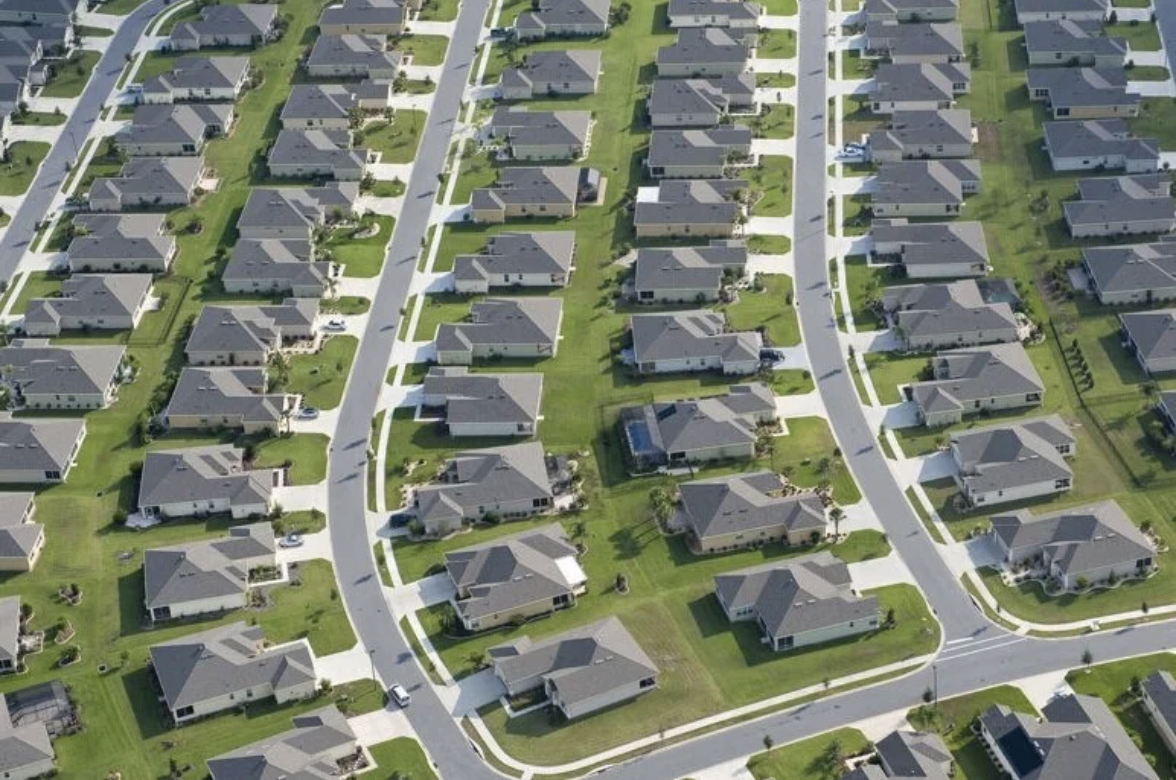
THIS is what Utopia actually looks like. No place. Shutterstock
As I remember James Kunstler point out in an interview: get thrown in the trunk of a car, driven around America, and let out in a parking lot, and you couldn't say what state you were in without checking the license plates. His TED Talk on the problem is exasperated, funny, and worth twenty minutes. [link]
His point underneath the jokes is that the public realm has to tell us not only where we are geographically, but where we are in our culture — where we've come from, who we are, and, if it's doing its job, a glimpse of where we're going.
What I'm actually hoping for
I have no illusions about making a perfect place. Everyone who's tried has failed, and I will too.
But fear of failing isn't a reason not to try. The plan is to learn from every failure so far and fail a little less—hopefully a lot less—keep an open mind, and do better as we learn how.
What's the alternative? Not try? Give up?
No thanks. We can't make a perfect place, but we can certainly do better than most of what we've got.
Places with a great sense of place
So what makes a place more Eutopian than Utopian? At their best, the places we make embody their time, their place, and their culture.
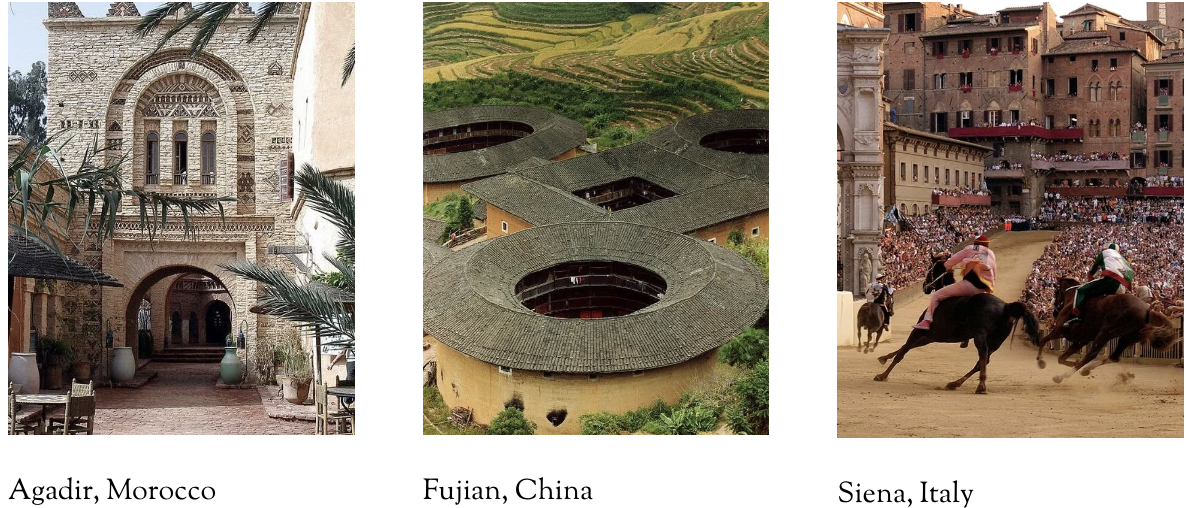
Natural, local materials. All three of the places above are great partly because they're made of what was there. Siena is the clearest example I know: a town built almost entirely from the earth of its own site. When you enter, the ground seems to rise up around you and take the form of twelfth-century Italy, and you're immersed in a color, a smell, a culture so distinct that the town is a UNESCO World Heritage site and its name is used the world over for the color of its earth. Siena is terroir you can live in.
Building with natural, minimally processed local materials is one of the surest and fastest ways to connect a built place to its spot on the planet. It also lends an instant sense of history and timelessness that most new construction desperately lacks.
Site-specific. It's easier and faster to level a site before you build. It's also short-sighted. You're far more likely to get magic if you work with the site's quirks — the topography, the sight lines, the old trees, the odd corner. The features that came with the land are the first layer of character, and they're what make the finished place unrepeatable. Bonus points: save the best of them for everyone, not just the lot that happens to contain them.
In short
Utopia means a placeless place — and honestly, that's where most of us already live. A truly beautiful place is the opposite: completely specific to its land, its climate, and the people who live there, the way terroir describes what makes a wine taste like nowhere else.
So no, I'm not trying to build Utopia. Eutopian, though? That's a name I can live with.